
By Lama Lhündrup (Frédéric La Combe)
We do not believe what we know. In other words, the Coronavirus teaches us many things that we pretend not to know. Epidemics seem to be reminders, calling up the fragility of our existence and of our social systems, bringing back to memory the face of the absolute, of God or of the reality of impermanence, depending on the point of view. In this sense, they are a spur to understand the relationship we have with death, which naturally reveals our relationship to life. The reality of impermanence and death is at the center of Eastern as well as Western wisdom: “All that is born, dies”, “all compound phenomena are impermanent”, says the Buddha and “we die from living”, said Heraclitus.
Have we caught the plague?
For a religious person as for a humanist, the relation to death is the “big deal” that conditions the vision and the way of life. Close to us, I am thinking about the work of the French writer, Albert Camus who made of his novel, “The Plague” a poignant lesson of humanism. His genius puts forward the ethics inherent in the human heart which pushes him, against all odds, to be supportive and active in relieving suffering. He affirms the value of virtues, the legitimate aspiration to happiness and the beauty of human dignity in the face of death. This, without calling for a metaphysical or ideological system. Doctor Rieux, hero of “The Plague”, heals and makes his job of healing a man’s duty. “If I believed in God Almighty, I would stop healing men, leaving him to do so,” he says. When he asks his friend Tarrou, who is not a doctor, why he takes care of the sick? The latter answered: “I don’t know, my morals may be”, “and which one? “Rieux retorts, “understanding”, answers Tarrou. He will die of it.
The marriage of an Eastern and Western humanism
Understanding and loving is the whole story. Tarrou’s morality does not come from an external authority. His morality is that of “human understanding”. It is because he understands human reality with his heart that he acts. This agnostic attitude, intelligent and at the same time altruistic to the point of sacrifice, shows us that there is in Western humanism a very rich source of connivance with the ethical teaching of the Buddha whose source is also “understanding”.
Even though, in another respect, the “Reason” opposed to the “religious faith” pushes Camus to the point of making the absurd the post-modern philosophy par excellence and the “Revolted man” its herald, would not the Dharma that reconciles reason and its overcoming, without resorting to the monotheist joker, be the answer to the metaphysical abyss opened by the author of “The Stranger”? Meursault, the suicidal stranger of the eponymous novel, is a stranger to himself because he does not know himself, he does not know the nature of his mind. He dies a fool (meurt sot)! This issue, which we will not develop here, may be an interesting part of the encounter of the Dharma with the West.
What matters to us here is that beyond beliefs or nonbelief, Buddhists and Humanists join each other on fundamental human values that are part of our character as homo sapiens; in that respect they are universal. Matthieu Ricard, in his book “Altruism, the power of compassion to change the world and yourself”, has shown it well. The great physician, as the Buddha is sometimes called, speaks in the same vein, even if he goes further. The Bhagavan, the Blessed One incorporates in the humanistic ethic, a primordial wisdom that comes from the knowing and experience of the nature of mind itself.
The Buddha, the Knower, does not tell us that we can suppress suffering, illness, old age and death, but that we have the capacity to free ourselves from its bondage by realizing, through contemplation, the emptiness of the suffering self. This experience of the Buddha’s awakening is known as the liberation from both fundamental ignorance and the blindness of intelligence in all its forms. This is not unrelated to Albert Camus’ observation:
“The evil in the world almost always comes from ignorance, and good will can do as much damage as bad will if it is not enlightened. Men are more good than bad, and in truth that is not the point. But they are more or less ignorant, and this is what is called virtue or vice, the most despairing vice being that of ignorance which believes it knows everything and which then allows itself to kill. The murderer’s soul is blind, and there is no true goodness or beautiful love without clear-sightedness.”
Four medical realities
What does this have to do with what we can learn from the pandemic? We can see an axiological relationship, that is one relating to the values that structure and animate our perception of ourselves and our way of life. If we are sincere, we learn that, in front of the reality of impermanence, suffering and the greedy or blind egotistical gestures and postures of personal and institutional powers, we have the freedom to draw on the human values that are present in our heritage and in our hearts. We also have the good fortune to be able to transform ignorance and its destructive passions by drawing on the primordial sources of the Buddha’s teachings which illuminate with dazzling clarity the timeless roots of human experience and provide the means to realize its highest potential, here and now.
In this time of pandemic, we may recall the medical paradigm of the Buddha’s four noble truths, not as a substitute for science, but to renew our experience of life in light of wisdom. These truths are realities: suffering, the cause of suffering, sanity, and the path that is the cure for achieving sanity. By understanding them as such, the four noble realities can help us recognize the reality of suffering and motivate us to transform its causes; they can vividly remind us of the reality of our fundamental inner health and that we are healthy before we are sick; finally, it is the reality of the path that plants the seeds of confidence in the therapy restoring the original sanity which is harmony, happiness and freedom.
A virus revealing deeper ills
The Coronavirus reminds us not only that we are mortal as individuals but that our globalized techno-scientific society is mortal too. The virus exposes the underbelly of the multi-crisis that is shaking our modern civilization and takes part in its foreseeable collapse.
The denial of death is perhaps the first axiom of our modernity and the fundamental brick on which its horizon is built: individualism. To adhere unfailingly to the omnipotence of the individual, one must deny his death. That may be our thickest veil.
A crisis of intelligence
Denys Rinpoche, meditation master and superior of the Rimay Buddhist Community (France), says: “At the root of ecological, economic, societal and human crises is a cognitive crisis, a crisis of consciousness that has its origin in the cognitive grasping that has generated it.
The problem is that we have exiled ourselves from nature, from our nature, into a world of representation, containing nothing but mental concepts, a bubble of mental consciousness that cuts us off from nature, the nature that we are. Our overwhelming reliance on mental representations in our daily existence makes us live in a closed virtual world. This enlarged and overwhelming conceptual realm in our mind goes hand in hand with the enlargement of our ego: the more cognitive grasping, the greater is the ego. We suffer in some way from an “acute egotic flu” whose manifestations appear in our society’s individualism and our selfish materialism”.
In this regard, Edgar Morin, the great French humanist and philosopher, early resistance fighter in 1940, who will celebrate his centenary this year, denounces this cognitive crisis in what he calls a “crisis of thought.” He tells us in essence:
“The crisis arising from the Coronavirus is a virulent symptom of a deeper and general crisis of the paradigm of the West that has become global, that of modernity, born in the European sixteenth century… The deficiencies of the thought, the enormous black hole in our mind, makes us disjoin what is inseparable and reduce to a single element what forms a whole at the same time one and multiple; it separates and compartmentalizes the knowledge instead of connecting them. The deficiencies in the way of thinking joined to the domination of an unbridled thirst of profit, are responsible for innumerable human disasters, of which those occurred in 2020… The awareness of the community of terrestrial destiny between the living Nature and the human adventure must become a major event of our time: we must feel solidarity with this planet where our life is linked to its existence; we must not only manage it but also spare it: we must recognize our biological filiation and our ontological filiation; it is the umbilical cord that we must renew”.
The Trojan horse
Universal wisdom tells us that in nature, death is not the opposite of life, life is birth and death. The Coronavirus could be the Trojan horse of nature that enters the almost hermetic mental bubble in which humanity seems to have locked itself. Will the small breach be salutary?
In short, facing what the United Nations already stigmatizes as an “existential threat”, the virus may be the trigger for a revolution, an inner revolution based on an axiological metamorphosis of values. This is the only viable future, the virus whispers in our ears. It is a question of drawing again from the origins of Knowledge and Ethics, for the Renaissance of a spiritual and ecological humanism, regenerated in nature and in our nature.
Oases of life
We can trust the resources of our heart and mind to cross fears and act altruistically and ecologically, right where we are. It’s about starting with ourselves, in our bodies, our hearts and our minds. Inwardly we can meditate a little more and practice mindfulness. Externally, we can implement this nonviolent revolution locally in the countryside and villages, by creating oases of life.
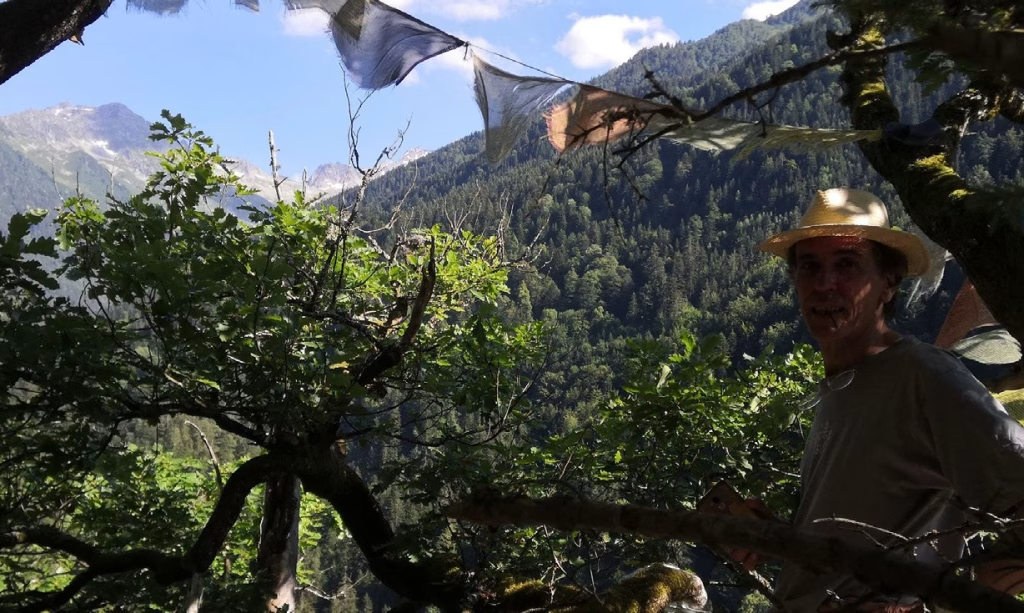
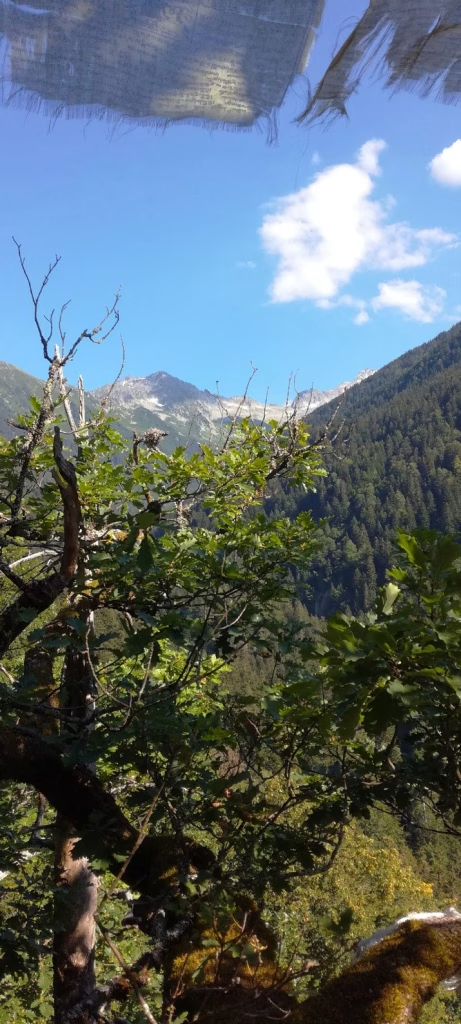
There is in France a growing development of these kinds of collective projects inspired by the extensive “Colibris network” founded by the renowned pioneer in ecology Pierre Rabhi, and coordinated by “La Cooperative Oasis”. The Buddha University and its “yogic village” in the French Alps is part of it.
Let us be united and daring, let us contaminate ourselves with an irrepressible pandemic of intelligence and love, and let oases of life flourish!
About the author
Frédéric La Combe (Lama Lhündrup) is a Dharma instructor and mindfulness facilitator, translator and graduate of a master’s degree in Chinese. After having lived several years in China, he made a three-year retreat in the Tibetan tradition under the guidance of Denys Rinpoche. He has been working in the service of the Buddha’s teachings and the Buddha University for the past twenty years. Organizer of numerous inter-tradition meetings in a humanist vision of unity in diversity, he is interested in the meeting of the Buddha’s wisdom with our life today, particularly in the fields of deep ecology and others. All pictures in this article are from Frédéric La Combe.
This article first appeared in EBU Magazine #7 – Death and Dying from a Buddhist Perspective (Autumn 2021). Download the full issue as PDF or browse all issues.