
By Lama Dondrub – Talk at the EBU conference “Buddhism in Europe: Unity in Diversity”, Nantes, April 2022

Something that I have always admired is the ability to be yourself in all possible situations and especially being yourself among people. It is a skill that I try to develop by reflecting on the situations in which I find myself in life.
Today I want to share with you this scheme that someone taught me a while ago and that helps me to clarify myself. It consists of paying attention to these four sections before making an important decision. The idea is to generate a chart or table with the contents: You want, You don’t want, You have, You don’t have.
In a square you will have what you want and do not have.
In another you will have what you want and have.
In another what you do not want and do not have.
In the last what you do not want and have.
In what box do you think I try to put my vital energy?
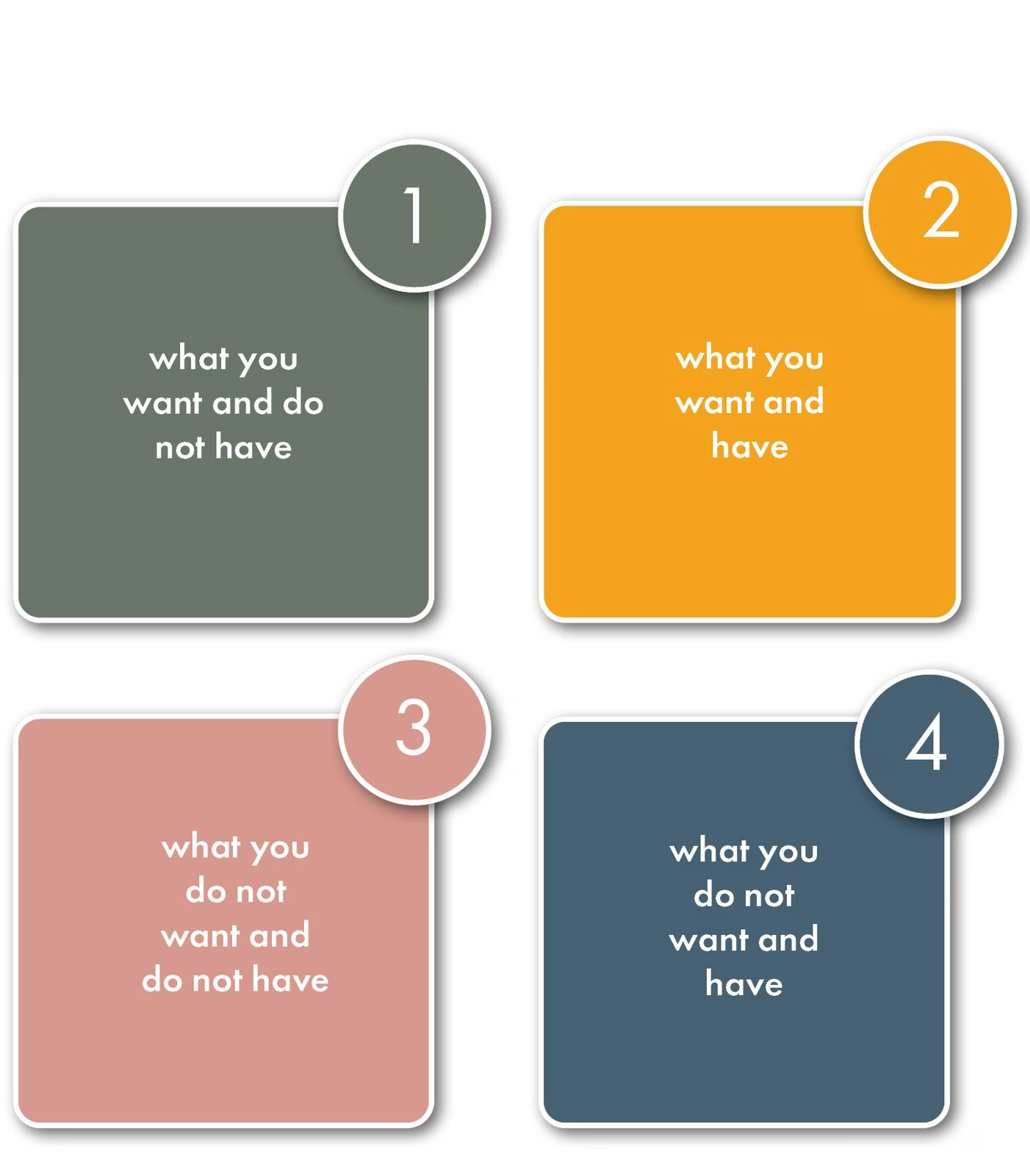
What you want and don’t have: The first helps me set short, medium and long-term goals. I write down the topics that motivate and inspire me.
What you want and have: The second helps me to value what I have already achieved and that perhaps I am forgetting about it. Sometimes focusing too much on what I don’t have and want prevents me from enjoying what I have already achieved. This second table is very important, because what I don’t want to happen is that when I lose something that I have, that is when I begin to value it.
What you don’t want and don’t have: The third is the one that is the most difficult for me, since it consists of opening my mind to what happens in life. Sometimes I get in trouble for going into situations that I already know I don’t feel like it. Let’s watch how we act so as not to cause what we write in this box to be what we have in the future.
What you don’t want and have: The fourth is the easiest for me, knowing that I have more than enough of what I currently have, and what I don’t want. But curiously, sometimes I discover situations that I have become so used to that I almost forgot that I do not want that. The ability to adapt to what we have is great to survive, but we must be careful that it should not be the one that is making the important decisions of our lives.
I hope this table will serve you as much as it has helped me. It can also be used to work with other people: couples, friends, family, work team… Doing the reflections out loud, being careful not to judge and not criticize the comments of others, enhances interpersonal relationships, since we will end up getting to better know the current situation of the people with whom we live.
Dedicating time to these reflections and meditations helps me to harmonize my mind and from there to manifest what I think is most useful and beneficial for me and for my environment. These types of exercises bring out information about myself that I was not aware of.
I don’t know about you, but it happens to me that by focusing on the goals that I set for myself, sometimes I forget what is important to maintain when I achieve those goals. I try to find the balance between what I want and what it really gives me. In fact, sometimes I’ve wanted something that didn’t really bring me anything, but I hadn’t discovered it until I had achieved it.
Well, I believe that this type of reflection and meditation improves us both personally and in our relationships with others. Being aware of what you expect from the situation or from the people, what you can contribute and what you are willing to use, I think is something fundamental and very useful for those of us who want to make the most of the opportunity that life offers us.
The great opportunity to have a physical human body and to be connected with the Dharma can easily be missed if we are not aware of what we decide to do with the time. That is why I want to share with you a second table to detect time thieves.
This time, the texts in the table are: Important, Not Important, Urgent, Not Urgent. There are several ways to use this table, but basically it consists of making a list of all the actions that we carry out in a common day, from the simplest to the most complex, and then placing them in the corresponding box.
What do you think of the proposal? Which box would you like to spend more time in?
This exercise forces us to determine what is important to us and that will only become apparent if we have clear objectives, which in turn will only be evident if we are clear about the meaning of our life.
The first box will be Important and Urgent.
The second will be Important and Not Urgent.
The third is Not Important and Urgent.
The fourth is Not Important and Not Urgent.

When I am dedicating time to important things, I have the feeling that I am doing what I have to do, when and how I want to do it. In my case they can be situations that only I can do and that I think I should do. There are importances that are more relative than others. For example, something very important would be something that if I didn’t do it, I would be left with a feeling of emptiness and frustration. The inner voice that we all have is responsible for reminding us from time to time.
When I am doing something not important, the feeling I have is that time has passed, I have not contributed something that is crucial for me. Thoughts come to me like: this could be done by any other person without the need to have the preparation that I have.
Urgent is everything that pushes you, that forces you to act quickly. That if you don’t do it now, you won’t be able to do it and therefore, either you or someone else will suffer the consequences. Urgent normally comes with a feeling of pressure, of rush, of stress.
Not urgent, therefore, is when you can do something with time, without haste, without jitters. You can dedicate the time you consider and undertake it when you feel like it.
In which square do you think it makes more sense to stay the longer the better?
What I think we all agree on is that being constantly in the Not Important and Not Urgent is going to leave us with a considerable feeling of emptiness. Our life will have no meaning: we neither contribute nor are we needed.
I like when I’m in Important and Not Urgent, because that way I can dedicate as much time as possible to the task at hand.
I know several people who are very comfortable in Important and Urgent, they say that urgency improves their point of concentration and that way they give the best of themselves.
And you, what is your ideal square?
I suggest you stop for a moment and think, in your present situation, what percentage you live in each section, on a normal day.
From my experience in dealing with people I have seen that these types of exercises in which we ask ourselves what we think about the issues and about life are not common practices. I have met many people who are uncomfortable, feeling bad, but do not know why. Because “what remains abstract cannot be improved”, they spend their days with these feelings of emptiness, discomfort and not knowing what to do with their lives. By using this table, it allows the information causing these feelings to become visible, no longer abstract.
Meditation helps us in this process of self-knowledge and harmonization. Once we are well with ourselves, the next step comes, and that is sharing our light with the beings around us.
Share my inner world with others
The personal research process makes us feel good about ourselves and in theory it should help to make what we contribute to our surroundings luminous. It is very pleasant when we connect intimately with some being thanks to mutual understanding. When you feel understood, the presence of the other generates an entity called “we”. In this experience the “I” relaxes and expands to give us a sense of spaciousness, connection, belonging, importance. When consciousness manifests itself without fear or filters, it allows its buddha nature to be glimpsed and from there we can enjoy love, compassion, joy and equanimity. Now, how do we share these wonderful feelings?
Communication is an art and certain principles must be taken into account if we want to use it to improve the world.
Correct communication is when the interlocutor creates in his mind an identical image to the one the sender of the message has. And as we already know, that has its complications.
First it is important to know what you want to convey, the clearer you have it, the better. Then you will have to know who your message is addressed to and what you expect to happen when the listener receives it. Next, it is time to decide on the best communication strategy. When all this process has finished, now it is time to issue the message according to the means that one has (voice, image, texts,…) always considering the state and present abilities of the listener. Finally, it will be time to check that the process has been carried out correctly.
As you know in Buddhism we have specific sutras on correct communication. For example, in his first speech as the Buddha, in what we know as The Four Noble Truths, he declared the four parameters to apply in our communication so that it facilitates awareness and enlightenment for oneself as well as for others:
- Truthfulness: which has to do with objectivity and sincerity.
- Kindness: we take the interlocutor very much into account when transmitting our message. We adapt it the best way we know how.
- Utility: There are different levels of utility, the highest is to help raise the consciousness of others.
- Foster authentic connection: by promoting concord, harmony and union.
As what we manifest arises more and more from luminosity and less from automatic processes, we accumulate direct and enriching experiences. Thanks to these experiences, it is easier to connect with the meaning of life, since it becomes visible and is reinforced through communication, to the point that it ends up being the driving force behind our thoughts and actions. When we act from that state and live it from our center, we become generators of positive environments, we live experiences and learn from them directly. We will no longer be talking about theories, it will be our own experience that will reinforce us and from there the practice of the Dharma will be increasingly essential and natural. The meaning of life and the practice of the Dharma will no longer be two different subjects.
From my point of view, what we call a spiritual path, the search for truth, authentic happiness, absolute happiness… is nothing more than this whole path towards consciousness. I have no doubt that this type of connection with oneself makes it easier to bring out the meaning of life and the motivation to dedicate what is necessary to it until we definitively align ourselves with it.
Living with a group of people matured through this inner work generates two great benefits: on the one hand, it enriches you as a person and on the other, it forces you to continue growing to be worthy of belonging to that group of practitioners.
As I want for myself, and for all the beings who also appreciate it, this type of space, and I consider that the Sangha is the maximum exponent of this activity, a few years ago I decided to dedicate myself to cultivating, preserving and promoting the generation of groups of practitioners, that is, the Sangha since I consider that it is the guarantee of success on the path to Enlightenment.
Dependence, independence, interdependence
When you go through this process, perhaps it is a good way to make the path of inner growth visible. As human beings we are born totally dependent. Without the help of others we could not live. Then over time we can fend for ourselves, until the time comes when we feel like a totally independent being. Later we notice that impulse to contribute to others and generate groups, families, societies…
The inner path passes through exactly the same stages: We start with a completely chaotic mind, thoughts, sensations and emotions run through the mind generating all kinds of internal conversations, ideas, projections and mental states. This is the dependency phase.
With practice we are able to separate the different components to relax the automatisms and allow the interior luminosity to manifest. There comes a time when we feel good about ourselves, we don’t need anyone. This is the independence phase.
After a while of checking how our mind works and realizing that there are many beings who have not yet realized it, we feel the need to share with others in order to help them. From our independence arises interdependence.

We become luminous beings motivated to share that light with others so that they are able to find their own. And for this it is important to learn not to lose it in the attempt. There is no point in losing your light to help others to activate theirs. Whatever happens, don’t lose your light.
Making this path inward empowers you to accompany others on their own path and thus, together, generate a more conscious, more luminous world.
The being that illuminates his interior ceases to have an idea of himself as completely separate from others. In fact, the very idea of “I” ceases to have so much importance. In the quantum world it is not so obvious where I begin and end, or what I am or am not. In that world, which is the place that the Dharma practitioner inhabits, the only thing that counts is empowering consciousness, going beyond the limiting beliefs that disable us from enjoying our true essence. It is absolute happiness, beyond any idea that I can comprehend.
Masters say that when you turn on your inner light you see in detail both the smallest particle and the entire universe. That matter ceases to be an obstacle to knowing. That what we call mind is nothing more than infinite spaciousness and luminosity. Any attempt to explain the experience falls short.
Sangha of sanghas
Practitioners from all over Europe meet from time to time to share, learn and support each other on this path to Enlightenment. It is fantastic to see how each tradition has adapted the teaching of the Buddha to the situations it has been encountering for 2,600 years.
Each tradition defines its own method to undertake this inner process, so we find different ways of practicing the Dharma. We find different ways of dressing, different texts, different skills to develop, different exercises, different indicators of the way.
At EBU we meet practitioners from different sanghas, each one brings their learning, their experiences and their desire to share the best of themselves to help enable the practice of Buddhist Dharma.
Heterogeneous unity in a powerful diversity
When we meet and acknowledge we elevate our idea of sangha. Together we generate a multicolored and multifaceted unit in which we all feel as one. No one is trying to convince anyone that their tradition is better than the other, since the being before us is a living example of the effectiveness of that tradition. And it is precisely this diversity that provides us with everything that is needed to illuminate the path of Dharma practice in Europe.
Thank you for your attention and awareness.
About the author
Ven. Lama Ngawang Dorje Dondrub has been a Sakya Buddhist teacher for more than 15 years and is an expert in the application of Buddhist philosophy in personal development, both in individuals and in organisations and companies. Through his monastic life he has developed a special skill in unravelling the Dharma to positivise the individual in the face of everyday difficulties and to transform ordinary conflicts into wonderful challenges. “If you grow you help and if you help you grow.”
This article first appeared in EBU Magazine #9 – EBU Conference 2022 – Buddhism in Europe: Unity in Diversity (Autumn 2022). Download the full issue as PDF or browse all issues.