
By Ton Kamphof
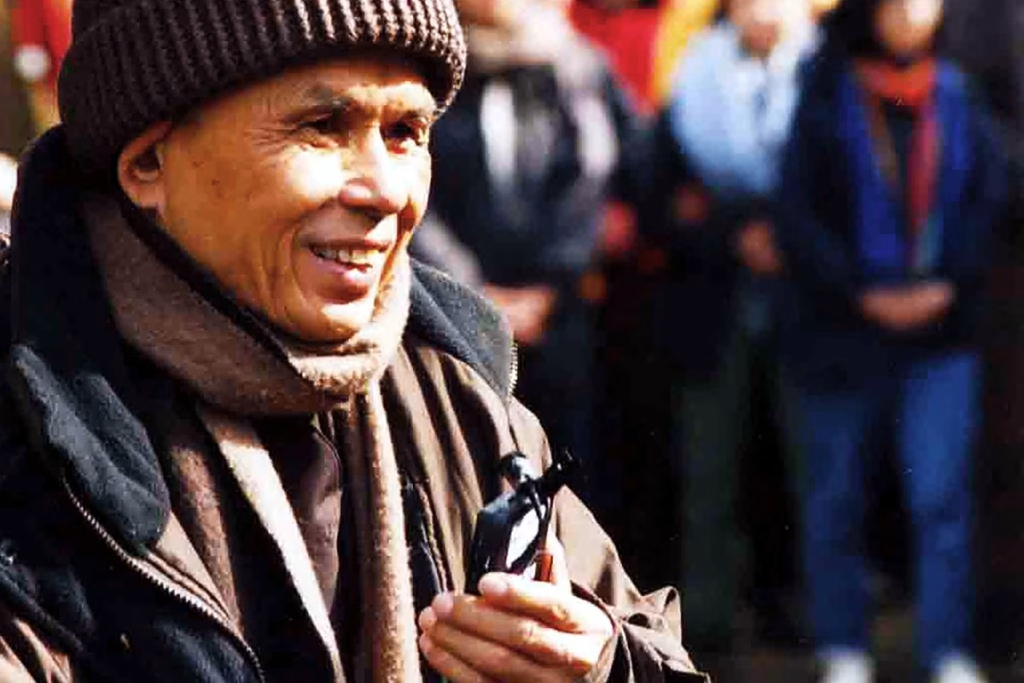
I have been asked to write about the way I remember Thich Nhat Hanh. He was a dear and special Buddhist teacher to me. Together with the Dalai Lama, he was for many years a world-renowned teacher, being a teacher-of-life, also for non-Buddhists. In January he died in Vietnam. 95 years old. Seven years earlier he had a stroke and for the rest of his life, he was seriously handicapped.
Thay (as we call him, it means ‘teacher’) came into my life because I was looking for a teacher that connected ‘the political’ with ‘the inner life’. I had heard that years ago, he had given much effort to help the victims of war, to end the horrible war in Vietnam through his ‘engaged Buddhism’. Buddhism in the middle of society and daily life. After his peace activities (foremost done in the West), he was forced to stay in the West. He established a monastery or meditation center in the South of France, called Plum Village. There he became the founding father of the mindfulness movement. I was curious and in 2003 I went – with my partner – for a retreat week to Plum Village.
Aware in the present moment
My first encounter was amazing, touching. Although it is now almost 20 years ago, I remember it as if it was yesterday.
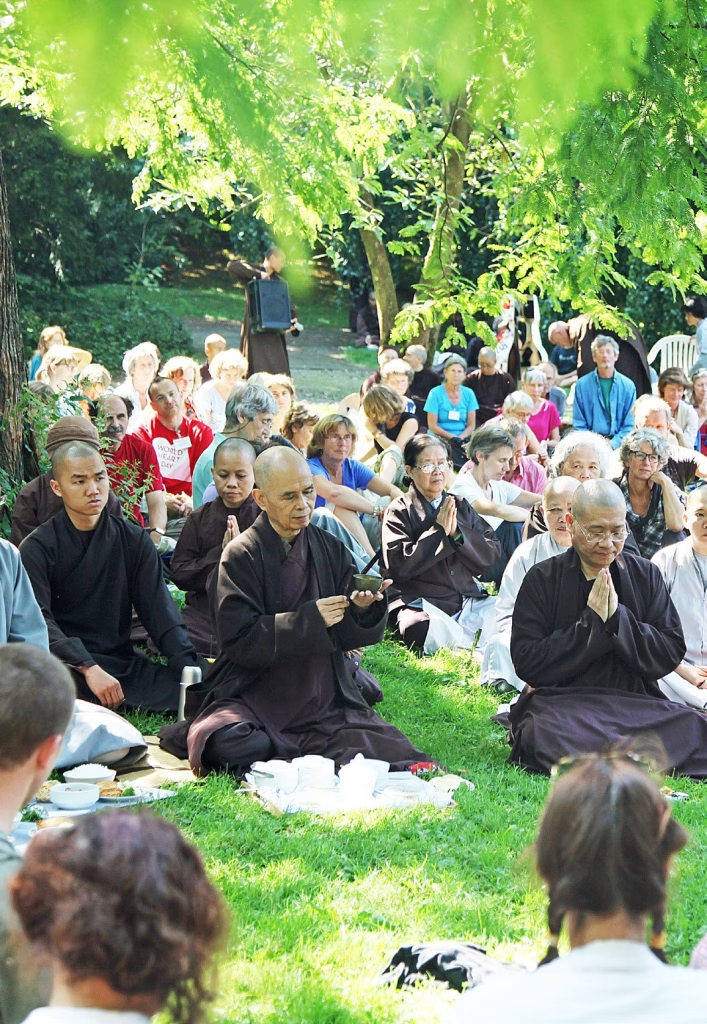
In the big hall with 400 people Thay entered the stage. I saw him for the first time. A small man. He spoke in a soft and intense way. Slightly introverted. He held a very long talk, much too long for me. I found my mind beginning to protest and getting caught up in inner discussions. Then, suddenly something else happened to me. Not only his words, but also slowly his tone, his presence began having an impact on me. I allowed myself to be touched by Thay’s words. They touched me like a gentle May rain. They dripped on the soil of my spirit, heart, and body. I heard: “You don’t have to go anywhere, you have already arrived, you are home. All happiness, all peace can be found in the here and now.” I heard: ‘you only live truly when you live in the now, attentive in the present moment. Not in a hurry’. And I was so often in a hurry! I heard: ‘slow down a bit and taste then what your life can be. Slow down, relax, enjoy. Do so, when you eat, when you walk, when you speak, when you work, when you act’. In Plum Village we were able to practice this right away. That was less easy than it sounded. And I must confess: this practice is still an invitation for me, every day. Living my life in a mindful, attentive way.
Practicing this all week, listening to him I felt his joy, the silence around him, his steadfastness and gentleness, his presence. They touched me deeply. So grateful!
Infectious serenity
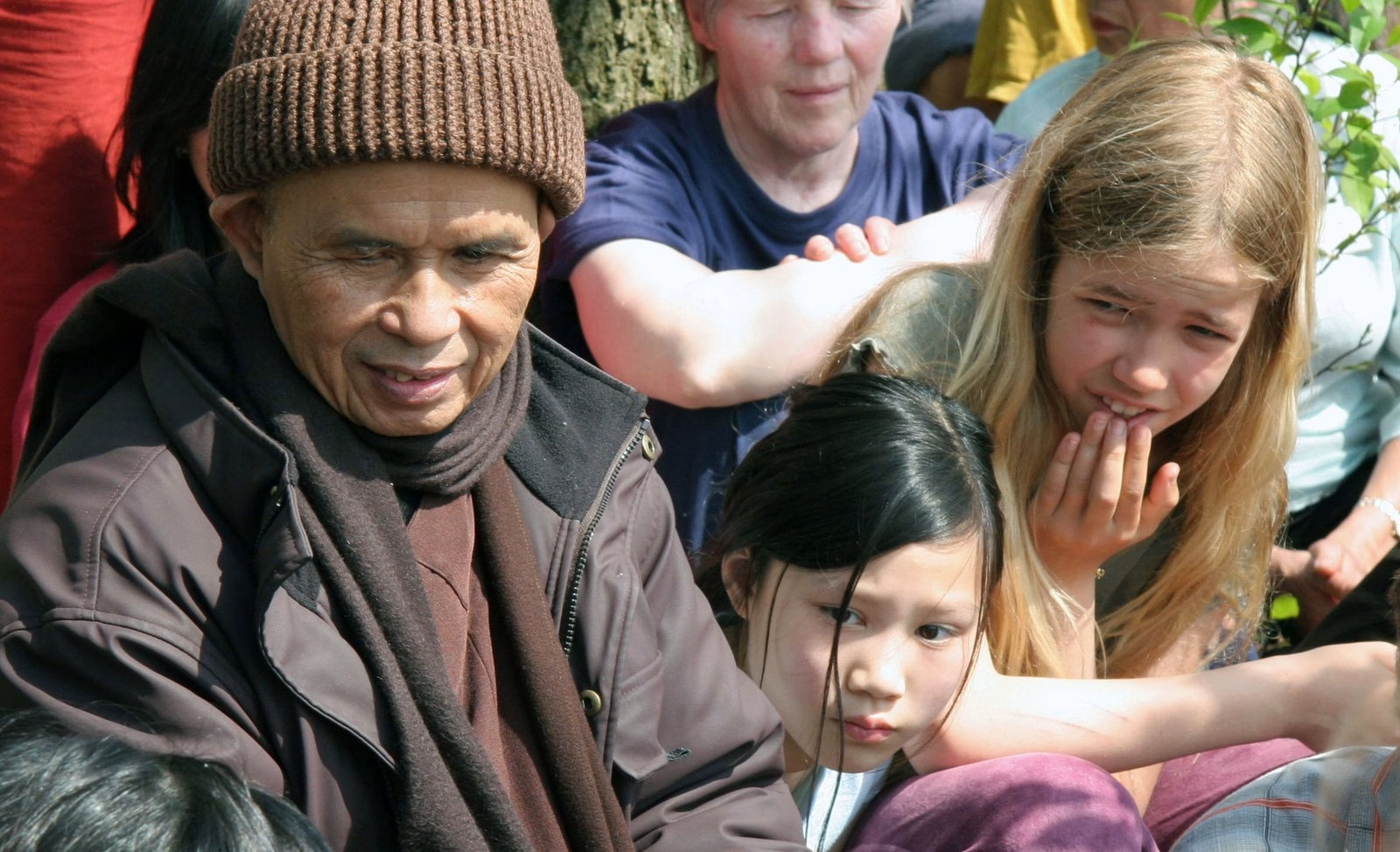
An American academic, and politically engaged man, Mitch, met Thay in the ’90s. He expressed it this way. ‘I sat with him at the Lincoln Memorial and listened to him read poems from the Vietnam War years and reflect on his efforts to share with Americans the suffering caused in both countries by the war. Then we walked silently, reverently past the Vietnam Veterans Memorial. I was deeply impressed by the quality of his presence, the flowing calmness of his words and actions and the remarkable effect it had on others. Sitting on a cushion, Thich Nhat Hanh spoke softly about love, compassion, about finding peace and joy in every step, in each action. His words and presence created an atmosphere of infectious serenity. The audience of 3000 was wondrously quiet.
Finding peace and joy in each moment, was a lovely idea, but how could I weave that way of being into the fabric of my urban American life….?’. That was Mitch. Nowadays he practices in Maryland, USA.
Healing the inner child
Wim, an inspiring guide for many, expressed it as follows. ‘Meeting Thay I felt that his teachings had heart energy. Thay did what he said. I am only inspired by people – teachers – who do what they say. Having met Thay and practicing in his tradition, I am much more in connection with my heart. That was not easy for me. It has been growing. I realize: my heart is the source of my love, my compassion, my mildness. What can I say: after all these years, I found more inner peace, and also a love for myself. I didn’t know that. In Christianity I learned the love for the other. But love for myself? It was a real discovery. When I got in touch with my own heart, I got in touch with its pain. I have always been very busy, very extrovert, etc. I asked myself: why all this action, why do I ask for so much attention? I discovered: that need came from the hurt of my inner child. On a very early morning during a retreat in Plum Village, I started talking to my inner child. I told him: ‘dear Wim, dear little boy of mine. I am so proud that you were so busy compensating, being so loud, being so active in the outside world… you have been so courageous to compensate the inner hurt. And then, when I felt my young heart, I had to cry. I said to my little one, my inner child: ‘you are permitted to cry, to cry as long as you want. Your tears are allowed to be there.’ Wim said: Thay has a great expression. ‘No mud, no lotus’. The more we care for the ‘mud’, the pain, the hurt, the ‘lotus’ in us can flower and shine. The lotus, our Buddha nature, our true nature.
Mindful and serious illness
Being mindful, being compassionately present in all the events of my life was especially felt by me through the case of the serious illness of my partner. In looking for a cure, she/we consulted numerous doctors, therapists, healers etc. etc. Unfortunately, to no avail. This situation fundamentally changed her life and our life together. It wasn’t easy at all…. Practicing attentiveness, complete and full presence, supported me in a wonderful way. Once, there was a moment where we thought: ‘she will leave this earthly life’. I discovered: there was no panic nor despair inside me, but calm and intimate nearness. I embraced her, we were very intimate, she was calm. So touching. At that moment, a field of presence arose that transgressed borders. Amazing. I am happy and grateful that this could happen. In a way, it made me stronger, generating a new inner strength. I realized: all is good, although it is not good. A surprising and wonderful discovery and realization!
And Thay himself was also an example. Despite all the destruction and pain and killing in the Vietnam War his heart remained open. His example was a transmission. Incredible!!
Inter-being
The view of inter-being in the tradition of Thay was new to me. If I see a flower, I see the sun, the earth, the water, the people who care for the flowers. Wonderful.
Without sun, no flower. Without water, no flower. All elements have their contribution to what arises. Amazing. Everything is deeply interconnected, deeply one. Inter-being is anti-ego. You no longer say: look at what I achieved. But: there are many circumstances, many conditions that had their contribution. Inter-being activates wonder and gratitude!
You can also see this in relation to the perspective of time. I am, because my mother was, my father was and their parents and their parents, and so on. They are all ‘in me’. I used to be an animal, a plant, a mineral, as Thay teaches. This insight became more than just a view. It became an experience for me. My goodness!! Who or what is the ‘I’ I think I am? This way, all limits and borders of a separated self disappear. I ‘am’ all of history, I am nature, I am as wide as the ocean. The planet is me. Caring for the planet, is caring for myself. Loving nature is loving myself. Loving myself is loving nature. Deep oneness opened itself to me.
Thay waved to me!
For 13 years I practiced in a sangha in Utrecht, the city I live in. I also guided the sangha for quite some years. I wrote a book on Thay, his message and his life. In Dutch. It was well received. I was happy to be of service, this way. At a certain moment, I decided to leave the sangha. I chose to solely practice in the stream of the Diamond Approach of A. H. Almaas. An inwardly deeper and more mystical path. I told them, wrote a letter to my sangha, and I inquired about this step with a spiritual friend. In the inner inquiry, I thanked Thay, I bowed to Thay, to the Buddha he was and is for me. And I had to cry, immensely. I couldn’t stop crying. And what happened? During this inner inquiry with eyes closed, Thay appeared. I saw him walking on a path alongside a forest. Covered by sunlight. He walked there, turned around and waved to me. He smiled, I smiled. I was very happy. It didn’t feel like an approval, it felt like a recognition. We deeply connect. Thay is always in my heart.
About the author
Ton Kamphof studied philosophy and theology, worked in industrial chaplaincy and as a trainer and consultant on the subject of safety and health at the workplace. He has written a handbook and articles on this theme and worked as a meditation and spiritual trainer. He has practised in the tradition of Thay and of the Diamond Approach for almost 20 years. He edited a special edition of “De Klankschaal”, the magazine in the Netherlands in the tradition of Thay/Plum Village, called “We thank Thay”. He practised 13 years in this tradition and co-guided a sangha in Utrecht (NL). He is the author of a well-received book (in Dutch) on Thich Nhat Hanh.
This article first appeared in EBU Magazine #9 – EBU Conference 2022 – Buddhism in Europe: Unity in Diversity (Autumn 2022). Download the full issue as PDF or browse all issues.