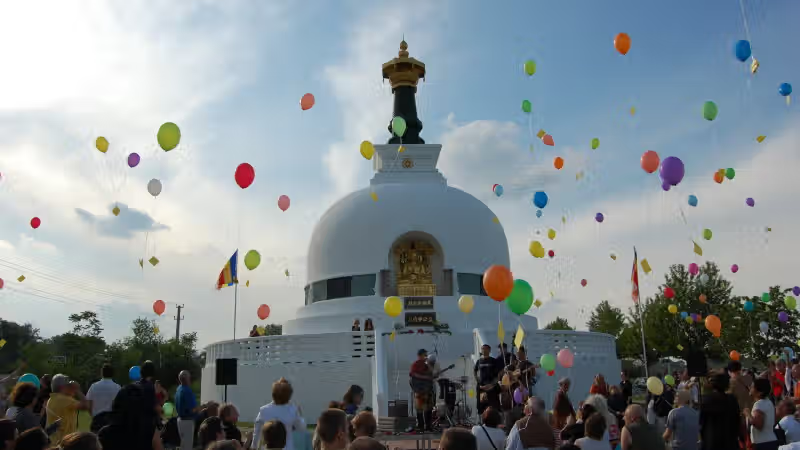

In Austria there are approximately about 35.000 individual Buddhists, and more than 4.000 are members of the Austrian Buddhist Union. Around 30 groups are also members of the Austrian Buddhist Union, taking care of about 70 temples and Dharma centers all over Austria.
In 1983 Buddhism was officially acknowledged by the Austrian government as a religion.
ÖBR on social media
https://www.facebook.com/Buddhismusinoesterreich
https://www.instagram.com/buddhismusinoesterreich/
https://www.youtube.com/user/BuddhismusAT
Socially Engaged Buddhism
It is of great importance for us to give society a wholesome impact, based on the teachings of the Buddha.
Voluntary members of our Mobile ÖBR Hospice attend to people during the last phase of their lives, regardless of their religious orientation or origin. They also take care of sick people. We provide support for our volunteers in team meetings, which are held on a regular basis, and by supervision.
Our Network Mindful Economy (NAW) is an association of people who want to make the treasures of Buddhist practice and wisdom useful for our times and especially for their economic activities. They organize Mindful Co-Working, lectures and workshops.
With our Prison-Chaplaincy we want to give people the opportunity to use their time of imprisonment for meditation and the study of the Dharma. Our offer includes one-to-one talks and in agreement with the heads of the institutions, also meditation and study groups.
Our daily lives are often far too hectic. With our group Buddhist-Youth, we try to provide space for timeout and peace for young people.
If you are interested in any of our various networks, please contact our office.
We welcome everyone who wants to participate in our networks!
The Roots of Buddhism in Austria
The first historically documented contact of an Austrian with Buddhism occurred sometime in the 17th or 18th century when a Jesuit missionary came in contact with Vajrayana Buddhism somewhere deep in the Himalayan mountains. No more details are mentioned in the chronicles. It is interesting though that today Vajrayana Buddhism has the greatest number of followers in Austria. Nonetheless, it took until the end of the 19th century before the first evidence of Buddhist activities in Austria could be found. It is the work of Karl Eugen Neumann, whose legal estate is stored in the Austrian Buddhist Union (ÖBR) archive. He was the first to translate the Pali Canon into German.
The Pali Canon contains the original holy texts of Buddhism in the so-called Three-Fold Basket—: The Basket of Discourses, The Basket of the Discipline for Monks and Nuns, and The Basket of Higher Teachings. At that time Buddhism mainly aroused scientific interest and not so much a spiritual one. Only after World War II did the first Buddhist groups establish themselves —the predecessors of today’s Austrian Buddhist Union.
In the middle of the last century, this religion, with its completely new concepts and philosophical approaches, gained wider attention in the West. It is a religion without the belief in a creator god and without dogmatism. These aspects, so contrary to the Abrahamic religions, were exactly the reasons why people who had been disappointed by their own religions were attracted to Buddhism and in this new religion they found a way to a new spiritual home.
Buddhism did not come to us through missionaries. It was first imported by scientists, and then religiously inspired people invited nuns and monks from Asia to introduce us to their teachings and Westerners travelled to Asia, to study the Dharma (the teachings), and then they became valuable teachers in Europe and also in Austria.
Before Buddhism spread to the West, it had mainly existed within its different traditions, isolated in the various countries where it had originally been practiced. Only after it had found its way into the West did these individual traditions meet; and thereby, a new form of development started. Up to this day there is no “Western” Buddhism. Each variation of Buddhism in the West has its roots in one of the different Asian traditions. They all co-exist here at equal value.
In 1983 Buddhism was officially acknowledged by the Austrian government as a religion. In order to meet the normative requirements of the West, the Austrian Buddhist Union was founded as an umbrella organisation, under which all Buddhist traditions and groups in Austria could be united on par with all the other officially recognised religions in Austria.
Austria was one of the first countries in Europe where Buddhism became an officially recognised religion. This kind of recognition also demonstrates how peaceful and beneficial cooperation of various religions is possible.
For the ÖBR, this acknowledgement was a gift of great value, and equally, a huge responsibility towards both the state and Austrian society. This task, however, is not seen as a burden, but rather as a wonderful opportunity, since it is a part of Buddhist practice and of the Buddhist path to take care of the wellbeing of all sentient beings. Naturally, this includes taking care of the welfare of the society in which the respective Sanghas (the Buddhist communities) exist. It is also the reason for the ÖBR’s many years of engagement in the European Buddhist Union.
The Austrian Buddhist Union has grown slowly but steadily during the last decades, and so have its tasks and requirements. Buddhism in Austria was barely noticed by the general public when it started out. However, over time the tiny sapling of the Buddha’s teachings germinated and grew slowly, well-sheltered in private homes that were turned into temples. They became the predecessors of today’s Buddhist Centre in Vienna’s first district.
After the death of its first president, Walter Karwath, the Austrian-born Zen monk, Osho Genro Koudela, presided over the ÖBR for 15 years. During his lengthy term in office, and thanks to his calm and careful management, the teachings of the Buddha in their huge variety of traditions were wholesomely established and developed. After him, his secretary general, Peter Riedl, followed as the third president. Since 2006 Gerhard Weissgrab has been the President of the ÖBR.
Contact:
A-1010 Wien, Fleischmarkt 16
Tel. +43 – 1 – 512 37 19
Fax. +43- 1 – 512 37 19 13